Florida homeowners are used to dealing with heat, humidity, intense sunshine, and unpredictable weather. While the state receives plenty of rainfall throughout the year, long stretches of dry weather can still put significant stress on traditional lawns.
When drought conditions develop, homeowners can find themselves watching their grass turn brown while local watering restrictions limit how frequently irrigation systems can operate. Keeping a traditional Florida lawn green can suddenly become a frustrating cycle of watering, fertilizing, mowing, and trying to repair areas damaged by heat and drought.
But what if your landscape simply didn’t need as much water or maintenance?
That’s one of the biggest advantages of EcoTurf perennial peanut sod.
EcoTurf provides Florida property owners with an attractive alternative to conventional turfgrass. Once established, perennial peanut is highly drought tolerant and can thrive with little to no supplemental irrigation under suitable conditions. It also offers additional benefits such as reduced mowing and fertilizer requirements.
For Florida homeowners concerned about drought, watering restrictions, maintenance costs, or simply spending too much time taking care of their lawn, EcoTurf offers another way to think about landscaping.
Florida Lawns Face a Unique Watering Challenge
Florida might not seem like a place where drought would be a major concern. After all, summer thunderstorms can produce tremendous amounts of rain in a short period of time.
The problem is consistency.
Florida can experience periods of frequent rainfall followed by extended stretches of dry weather. Sandy soils commonly found throughout the state can also drain quickly, meaning water doesn’t necessarily remain available to shallow-rooted plants for very long.
Traditional turfgrass can begin showing signs of drought stress during these periods.
Grass blades may fold, footprints can remain visible after walking across the lawn, and sections of turf may develop a blue-gray appearance before eventually becoming brown.
The typical response is simple: turn on the irrigation system.
But that isn’t always an option.
Watering Restrictions Can Make Traditional Lawn Care Difficult
Florida homeowners may be subject to watering restrictions established by their local government, utility provider, or water management district.
Depending on the location and current conditions, these rules can limit landscape irrigation to certain days or times.
Additional restrictions may also be introduced during serious droughts or water shortages.
That creates a challenge for homeowners with landscapes heavily dependent on irrigation.
Even outside periods of drought, running an irrigation system regularly means using additional water, maintaining sprinkler heads, repairing broken irrigation lines, adjusting timers, and paying for the water required to keep the landscape healthy.
For homeowners looking for a lower-maintenance landscape, reducing that dependence on irrigation can be a major advantage.
That’s where perennial peanut becomes especially interesting.
What Is EcoTurf Perennial Peanut Sod?
EcoTurf is a perennial peanut sod designed to provide an attractive, durable groundcover alternative for Florida landscapes.
Despite the name, perennial peanut isn’t the same plant used to produce the peanuts you buy at the grocery store.
Instead, perennial peanut is a warm-season perennial legume that spreads through underground rhizomes. It is particularly well suited to warm climates and has become increasingly recognized as an alternative groundcover in Florida.
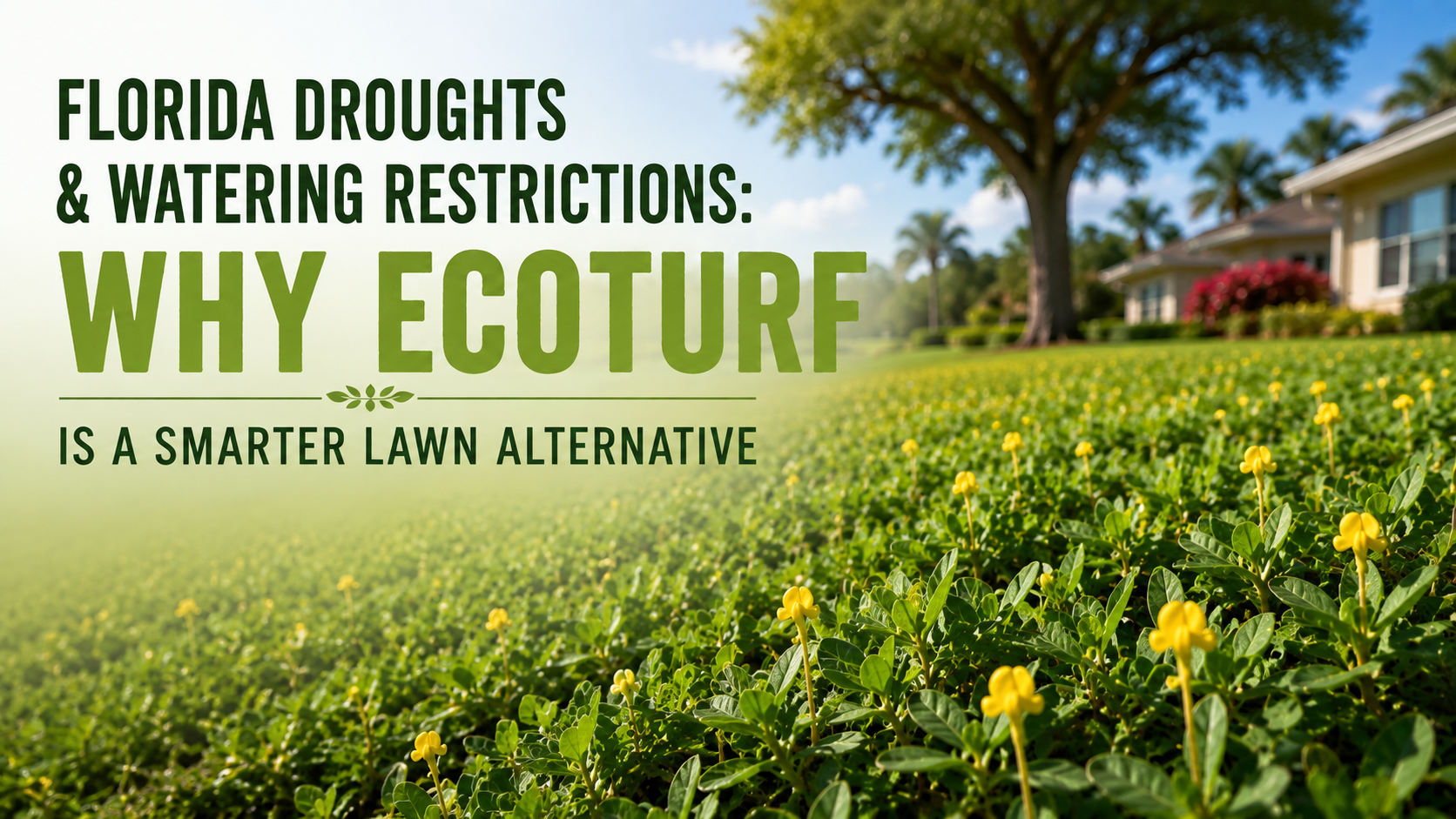
Once established, it develops a dense mat of green vegetation and produces attractive yellow flowers.
The result is a landscape that looks intentionally planted and colorful while requiring considerably different maintenance than a conventional grass lawn.
EcoTurf Is Extremely Drought Tolerant
One of the biggest reasons to consider EcoTurf is its ability to handle dry conditions.
Established perennial peanut is highly drought tolerant. Its underground rhizomes and established root system help it survive periods when rainfall is limited.
This means established perennial peanut can require little to no supplemental irrigation under appropriate conditions.
That’s a major difference for Florida property owners accustomed to maintaining turfgrass with a regularly scheduled irrigation system.
During extended periods without rain, EcoTurf may experience changes in appearance or growth. Drought tolerance doesn’t mean that any plant can remain completely unaffected by an indefinite lack of water.
But perennial peanut’s ability to withstand dry conditions makes it particularly attractive for Florida landscapes where conserving water is a priority.
New EcoTurf Sod Still Needs Water
There is one important distinction homeowners need to understand.
New EcoTurf sod still needs water during establishment.
When perennial peanut is first installed, it hasn’t yet developed the established root and rhizome system that gives mature EcoTurf its drought tolerance.
Proper irrigation during this initial establishment period helps the new sod become rooted into the soil.
This is similar to establishing many types of new landscaping. The plant needs additional care at the beginning so it can become stronger and more self-sufficient later.
Once properly established, the need for supplemental irrigation can decrease dramatically.
That makes the initial establishment period an investment toward a landscape that can ultimately require far less watering.
Spend Less Time Worrying About Your Irrigation System
Anyone who has owned a traditional Florida lawn knows that irrigation systems require maintenance of their own.
Sprinkler heads break.
Nozzles become clogged.
Grass grows over sprinkler heads.
Zones lose pressure.
Timers need to be adjusted.
One section gets too much water while another doesn’t get enough.
Then a heavy Florida thunderstorm arrives immediately after the sprinklers finish running.
Reducing your landscape’s dependence on irrigation can eliminate some of this constant attention.
For homeowners who want a yard that doesn’t require as much babysitting, EcoTurf can be an attractive option.
Less Mowing Means Less Weekend Yard Work
Water isn’t the only resource required to maintain a conventional lawn.
There’s also your time.
Traditional turfgrass may require frequent mowing during Florida’s growing season. Warm temperatures, rainfall, and fertilizer can cause grass to grow rapidly, leaving homeowners mowing week after week.
Perennial peanut requires considerably less mowing.
Depending on the appearance you prefer and how the area is being used, EcoTurf can be maintained with occasional mowing rather than the frequent schedule associated with many traditional turfgrasses.
That means less time pushing a mower, less gasoline or electricity being used, and fewer hours spent maintaining equipment.
For homeowners who would rather enjoy their property than constantly work on it, that’s a meaningful benefit.
EcoTurf Can Reduce Fertilizer Needs
Another major advantage of perennial peanut comes from something happening below the surface.
Perennial peanut is a legume.
Like other legumes, it works with specialized bacteria associated with its roots to fix atmospheric nitrogen. This allows the plant to obtain nitrogen in a way traditional turfgrasses cannot.
As a result, perennial peanut generally doesn’t require the routine nitrogen fertilization associated with maintaining many conventional lawns.
That can mean fewer fertilizer applications and a simpler maintenance routine.
It can also reduce concerns about applying unnecessary nitrogen to the landscape.
For Florida property owners interested in creating landscapes that require fewer inputs, perennial peanut offers an appealing alternative.
An Attractive Lawn Without the Traditional Grass Look
Choosing a lower-maintenance landscape doesn’t mean settling for a yard that looks neglected.
EcoTurf creates an entirely different aesthetic from traditional turfgrass.
Its dense green foliage creates a lush groundcover, while its small yellow flowers provide seasonal color across the landscape.
Instead of trying to imitate a conventional lawn, EcoTurf gives homeowners the opportunity to create something distinctive.
It can work especially well for homeowners who appreciate a more natural Florida landscape but still want their property to look maintained and intentional.
EcoTurf Can Be a Great Choice for Larger Properties
The maintenance savings associated with EcoTurf become even more noticeable as the size of a property increases.
Watering, mowing, and fertilizing a small lawn is one thing.
Maintaining a large Florida property covered in traditional grass can become a significant commitment.
Large irrigation systems cost money to operate and maintain. Mowing requires more equipment and considerably more time. Fertilizer and other lawn products become more expensive as the square footage increases.
Replacing suitable areas with perennial peanut can reduce some of those ongoing maintenance demands.
It can be particularly attractive for rural properties, larger residential lots, commercial properties, and other landscapes where maintaining acres of conventional turf simply doesn’t make sense.
What Happens During a Drought?
One of the greatest advantages of an established perennial landscape is resilience.
Traditional grass may quickly show stress when irrigation is reduced during dry weather. Homeowners can find themselves watching weather forecasts and worrying about whether they’re allowed to run their sprinklers.
Established EcoTurf perennial peanut is much better equipped to tolerate periods of limited rainfall.
Instead of designing a landscape around constant access to irrigation, you’re using a plant naturally suited to handling Florida’s warm climate and periods of dry weather.
That doesn’t mean EcoTurf will look exactly the same every day of the year. Seasonal conditions, temperature, rainfall, soil, and other environmental factors can affect its appearance.
But reducing your lawn’s dependence on supplemental irrigation gives you a significant advantage when water becomes scarce.
A Different Approach to Florida Landscaping
For decades, Florida homeowners have accepted a familiar lawn-care routine.
Water the grass.
Mow the grass.
Fertilize the grass.
Repair the irrigation system.
Treat the grass.
Then repeat.
EcoTurf offers an opportunity to rethink that cycle.
Instead of asking how you can keep a high-maintenance lawn alive with less water, you can choose a groundcover that naturally requires less maintenance once established.
The result can mean less irrigation, less mowing, fewer fertilizer requirements, and less time spent maintaining your landscape.
Is EcoTurf Right for Your Property?
Every property is different, and EcoTurf may not be the right choice for every individual location.
Sunlight, soil conditions, drainage, intended use, desired appearance, and other factors should all be considered before selecting any sod or groundcover.
But if your priorities include drought tolerance, reduced irrigation, lower maintenance, and a distinctive Florida-friendly appearance, EcoTurf perennial peanut deserves serious consideration.
This is especially true for homeowners who are tired of watching traditional grass struggle every time Florida enters an extended dry period.
Stop Fighting Your Lawn and Start Working With Florida’s Climate
Droughts and watering restrictions don’t have to mean constantly fighting to keep your landscape alive.
Sometimes the better solution isn’t finding another way to water traditional grass. It’s choosing a landscape that’s less dependent on supplemental irrigation in the first place.
EcoTurf perennial peanut sod provides Florida property owners with a drought-tolerant, lower-maintenance alternative to conventional turfgrass. Once established, it can require little to no supplemental irrigation under suitable conditions while also reducing mowing and nitrogen fertilizer needs.
That can mean less water, less maintenance, and more time to actually enjoy your property.
If you’re considering replacing traditional grass, installing landscaping on a new property, or simply looking for a lawn alternative that’s better suited to Florida’s challenging conditions, contact EcoTurf Sod today to learn more about perennial peanut sod and whether EcoTurf is the right choice for your property.
