
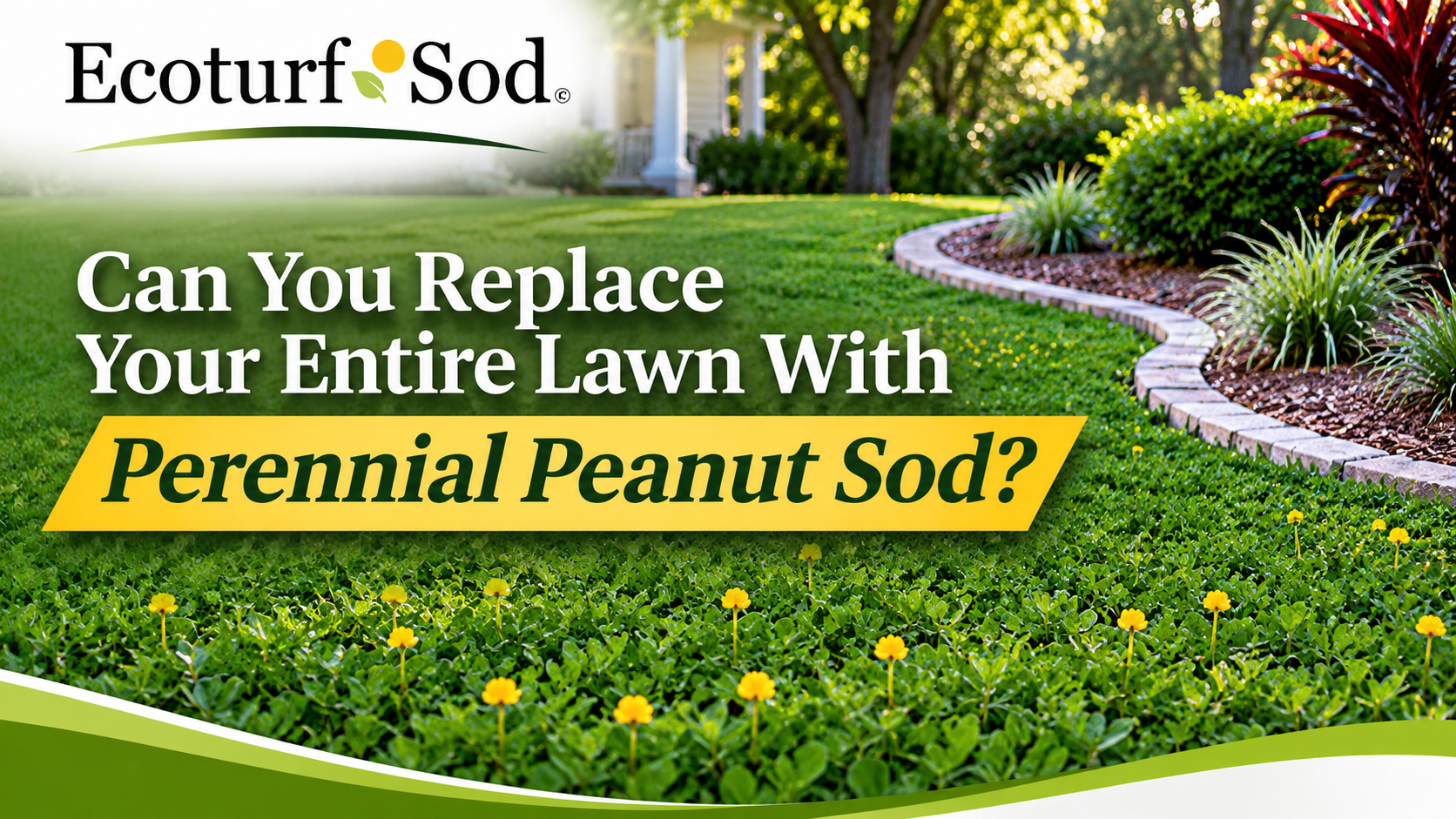
For many Florida homeowners, maintaining a traditional grass lawn feels like a never-ending responsibility. Between frequent mowing, watering, fertilizing, and dealing with weeds, keeping a yard looking attractive can require significant time, effort, and money.
But what if there were an alternative that required less maintenance while still providing beautiful green coverage?
That’s where perennial peanut sod comes in.
This increasingly popular groundcover offers Florida homeowners an alternative to conventional turfgrass. Known for its dense green foliage, small yellow flowers, drought tolerance, and relatively low maintenance requirements, perennial peanut is becoming an attractive option for residential and commercial landscapes.
But can you actually replace your entire lawn with perennial peanut sod?
The short answer is yes, provided your property has the right growing conditions and your lawn doesn’t need to withstand heavy foot traffic.
At Ecoturf Sod, we specialize in perennial peanut sod and helping property owners discover a different approach to Florida landscaping. Let’s explore how this unique groundcover works, its advantages, and what to consider before replacing your existing lawn.
What Is Perennial Peanut Sod?
Perennial peanut (Arachis glabrata) is a warm-season, perennial legume native to South America that has adapted well to many areas of Florida.
Although its name might suggest otherwise, ornamental perennial peanut isn’t grown for the edible peanuts commonly found in grocery stores.
Instead, it’s valued for its attractive appearance, spreading growth habit, and ability to provide relatively low-maintenance ground coverage.
Unlike traditional turfgrass, perennial peanut grows through underground stems called rhizomes. These structures allow the plant to spread and develop dense vegetation over time.
Its most recognizable characteristics include:
- Dense, bright green foliage
- Small yellow flowers during the growing season
- Relatively low-growing vegetation
- Good drought tolerance once established
- Minimal nitrogen fertilizer requirements
- Reduced mowing needs compared to conventional turfgrass
Perennial peanut is commonly used along roadsides, in residential landscapes, and throughout commercial properties.
With proper planning, it can also replace large portions of a traditional lawn.
Can Perennial Peanut Replace Traditional Grass Completely?
Yes. Perennial peanut can serve as the primary groundcover across an entire residential lawn, especially in areas receiving plenty of sunlight and relatively little foot traffic.
However, replacing an entire lawn requires understanding how perennial peanut differs from conventional grass.
Traditional turfgrasses such as St. Augustine, Bahia, and Bermuda are commonly selected for their ability to tolerate varying levels of recreational activity.
Perennial peanut, on the other hand, is generally better suited to ornamental landscaping and areas with light or occasional foot traffic.
For example, a large front yard primarily intended for curb appeal may be an excellent candidate for perennial peanut sod.
A backyard regularly used for children’s sports, large dogs running, or frequent outdoor gatherings may benefit from keeping conventional turfgrass in high-traffic sections.
The goal isn’t necessarily to replace every square foot of traditional grass. It’s to create a landscape that works for your property while reducing unnecessary maintenance.
7 Benefits of Replacing Your Lawn With Perennial Peanut Sod
1. Less Mowing and Lawn Maintenance
One of the biggest advantages of perennial peanut sod is its relatively low maintenance requirements.
Traditional Florida lawns often need weekly mowing during the warmer months.
Perennial peanut generally grows much more slowly in height than many conventional turfgrasses, allowing homeowners to reduce mowing frequency significantly.
Some ornamental installations may require only occasional trimming to maintain their desired appearance.
Actual maintenance depends on the variety, growing conditions, and homeowner preferences.
For anyone tired of spending weekends maintaining their lawn, this can be a major advantage.
2. Excellent Drought Tolerance Once Established
Florida receives substantial annual rainfall, but extended dry periods can still create challenges for homeowners.
Traditional turfgrass may require supplemental irrigation to maintain its appearance during drought conditions.
Established perennial peanut develops an extensive underground root and rhizome system that helps it tolerate periods of limited rainfall.
This makes it an attractive option for water-conscious landscaping.
However, drought tolerance doesn’t mean newly installed perennial peanut sod can survive without water.
During establishment, consistent moisture is essential for root development.
Once established, irrigation requirements can often be reduced considerably, depending on weather and soil conditions.
3. Reduced Need for Nitrogen Fertilizer
Another important advantage of perennial peanut is its ability to fix atmospheric nitrogen through a relationship with beneficial soil bacteria.
Because perennial peanut is a legume, it can obtain much of its nitrogen through this natural biological process.
Traditional turfgrasses often require nitrogen fertilizer applications to maintain healthy growth and color.
Perennial peanut generally doesn’t need routine nitrogen fertilization once properly established.
However, other nutrients may still be necessary depending on soil conditions.
Soil testing remains important for identifying phosphorus, potassium, pH, and other fertility considerations.
Reducing unnecessary fertilizer applications can lower maintenance expenses and support more responsible landscaping practices.
4. Attractive Green Coverage With Yellow Flowers
Perennial peanut offers a distinctive appearance that separates it from traditional lawns.
Its dense green foliage creates a carpet-like groundcover, while small yellow flowers add seasonal color.
For homeowners interested in a more natural landscape, this combination can be particularly appealing.
The flowers can also attract pollinating insects, including bees.
This can be beneficial for pollinator-friendly landscaping, although homeowners may want to consider flower placement around play areas and heavily used walkways.
Unlike conventional grass, perennial peanut provides both ground coverage and ornamental flowering characteristics.
5. Potential Long-Term Maintenance Savings
Replacing a lawn represents an upfront investment, but perennial peanut may help reduce certain ongoing maintenance expenses.
Depending on the property, savings may come from:
- Less frequent mowing
- Reduced nitrogen fertilizer purchases
- Lower irrigation needs after establishment
- Reduced fuel and equipment use
- Less time spent on routine lawn maintenance
These benefits can be especially valuable for larger residential properties and commercial landscapes.
However, actual savings depend on installation costs, site conditions, weed management, and the amount of maintenance required.
6. A Long-Lived Groundcover
Perennial peanut is a perennial plant, meaning it can survive and regrow over multiple growing seasons.
Once established under suitable conditions, it can remain part of the landscape for many years.
Its underground rhizomes help support regrowth following seasonal dormancy or certain types of damage.
Unlike annual plants that require regular replacement, perennial peanut offers a longer-term landscaping option.
Proper soil conditions, drainage, sunlight, and maintenance are still important for maintaining healthy coverage.
7. A Florida-Friendly Landscaping Option
Perennial peanut can support several principles associated with Florida-Friendly Landscaping, including selecting appropriate plants, conserving water, and using fertilizer responsibly.
Its drought tolerance and reduced nitrogen fertilizer needs make it worth considering for environmentally conscious landscapes.
However, perennial peanut is not native to Florida, and it shouldn’t be confused with a native groundcover.
Its suitability depends on the location and how the property will be used.
What Are the Disadvantages of Perennial Peanut Sod?
Although perennial peanut has many benefits, it isn’t the ideal choice for every property.
Understanding its limitations helps homeowners make better landscaping decisions.
Limited Heavy Foot Traffic Tolerance
Perennial peanut generally doesn’t handle repeated heavy traffic as well as turfgrasses selected for active lawns.
Areas used for sports, regular running, or frequent vehicle movement may experience damage.
For these locations, conventional grass or another durable surface may be more appropriate.
Requires Plenty of Sunlight
Perennial peanut performs best in full sun.
Properties with significant shade from large trees, buildings, or dense landscaping may experience thinner growth and reduced flowering.
Some varieties tolerate limited partial shade, but heavily shaded lawns generally aren’t ideal.
Seasonal Appearance Changes
Perennial peanut is a warm-season plant.
In North Florida, cooler temperatures and frost can cause the foliage to turn brown or die back temporarily.
The underground rhizomes can remain alive and produce new growth when warmer weather returns.
Homeowners expecting a consistently green lawn throughout winter should understand this seasonal characteristic before installation.
Weed Management Is Still Necessary
Although established perennial peanut can form dense groundcover, it isn’t completely maintenance-free.
Weeds can become a problem, especially during the establishment period.
Proper site preparation and ongoing monitoring are important for maintaining an attractive landscape.
How Do You Replace an Existing Lawn With Perennial Peanut Sod?
Replacing conventional turfgrass with perennial peanut requires proper preparation.
Simply laying new sod over an existing lawn generally isn’t recommended because established grass can compete with the new plants.
Step 1: Evaluate Sunlight and Drainage
Start by identifying areas receiving sufficient sunlight.
Perennial peanut generally prefers well-drained soil and doesn’t perform well in locations that remain saturated for extended periods.
Check for drainage problems and areas where water frequently collects.
Step 2: Remove Existing Grass and Weeds
Existing turfgrass and unwanted vegetation should be removed or effectively controlled before installation.
This helps reduce competition and gives the new sod direct contact with the soil.
Persistent weeds may require additional preparation before planting.
Step 3: Prepare the Soil
The soil should be prepared to create a suitable planting surface.
This may involve grading, addressing compaction, correcting drainage issues, and applying soil amendments when recommended by testing.
Good soil contact is essential for successful establishment.
Step 4: Install the Perennial Peanut Sod
Perennial peanut sod is installed over the prepared surface, with pieces placed closely together to minimize exposed soil.
Proper installation helps encourage uniform coverage and rooting.
At Ecoturf Sod, our perennial peanut sod offers property owners a convenient way to establish this attractive groundcover without starting entirely from individual plants.
Step 5: Water During Establishment
Newly installed sod needs adequate moisture while roots develop into the underlying soil.
Watering frequency should be adjusted based on weather, soil conditions, and establishment progress.
Avoid allowing the sod to dry out, but also prevent prolonged waterlogging.
Step 6: Limit Traffic and Monitor Growth
Avoid unnecessary foot traffic while the sod becomes established.
Monitor for weeds, dry areas, and uneven growth.
Once the plants develop strong roots and begin spreading, maintenance requirements can gradually decrease.
Is Perennial Peanut Sod Good for Homes With Dogs?
Homeowners with pets often wonder whether perennial peanut can replace their existing backyard grass.
Perennial peanut is not generally regarded as a poisonous landscape plant for dogs, but that doesn’t automatically make it the best surface for every pet area.
Dogs that frequently run along fences, dig, or play vigorously may damage the groundcover.
For properties with active dogs, consider using perennial peanut in decorative landscape areas while maintaining more durable surfaces in frequently traveled sections.
Also, flowering perennial peanut can attract bees, which is worth considering for pets that investigate insects.
How Much Perennial Peanut Sod Do You Need?
Before replacing your lawn, determine the total square footage of the area you want to cover.
Measure the length and width of rectangular sections, then multiply those measurements to calculate the area.
For example, a lawn measuring 50 feet by 40 feet contains:
50 × 40 = 2,000 square feet
If you’re purchasing sod in 200-square-foot rolls, that would require approximately 10 rolls before accounting for cutting, irregular shapes, or installation waste.
For complicated layouts, dividing the property into smaller measurable sections can make calculations easier.
Accurate measurements help avoid unnecessary material purchases and installation delays.
Is Perennial Peanut Sod Worth It for Florida Homeowners?
For homeowners who want an attractive, relatively low-maintenance alternative to traditional grass, perennial peanut sod can be an excellent investment.
Its drought tolerance, reduced nitrogen fertilizer requirements, and ornamental appearance make it particularly appealing for sunny Florida landscapes.
However, it’s important to consider how your lawn is actually used.
If your property receives heavy recreational traffic, has extensive shade, or requires year-round green coverage, replacing every section with perennial peanut may not be the best solution.
In many cases, a combination of perennial peanut and conventional turfgrass provides an effective balance between appearance, durability, and maintenance.
Transform Your Florida Lawn With Ecoturf Sod
Replacing your traditional lawn doesn’t have to mean sacrificing curb appeal.
Perennial peanut sod offers Florida homeowners an opportunity to create attractive landscapes while potentially reducing mowing, irrigation, and fertilizer requirements.
Whether you’re replacing an entire front lawn, creating decorative groundcover, or planning a larger commercial landscaping project, selecting the right plant for the right location makes all the difference.
At Ecoturf Sod, we specialize in perennial peanut sod and helping customers explore sustainable alternatives to conventional turfgrass.
Ready to discover whether perennial peanut sod is right for your property?
Visit ecoturfsod.com to learn more about our perennial peanut sod and contact our team about your landscaping needs.
